
Home › Guides
How to Read a Copyright Page
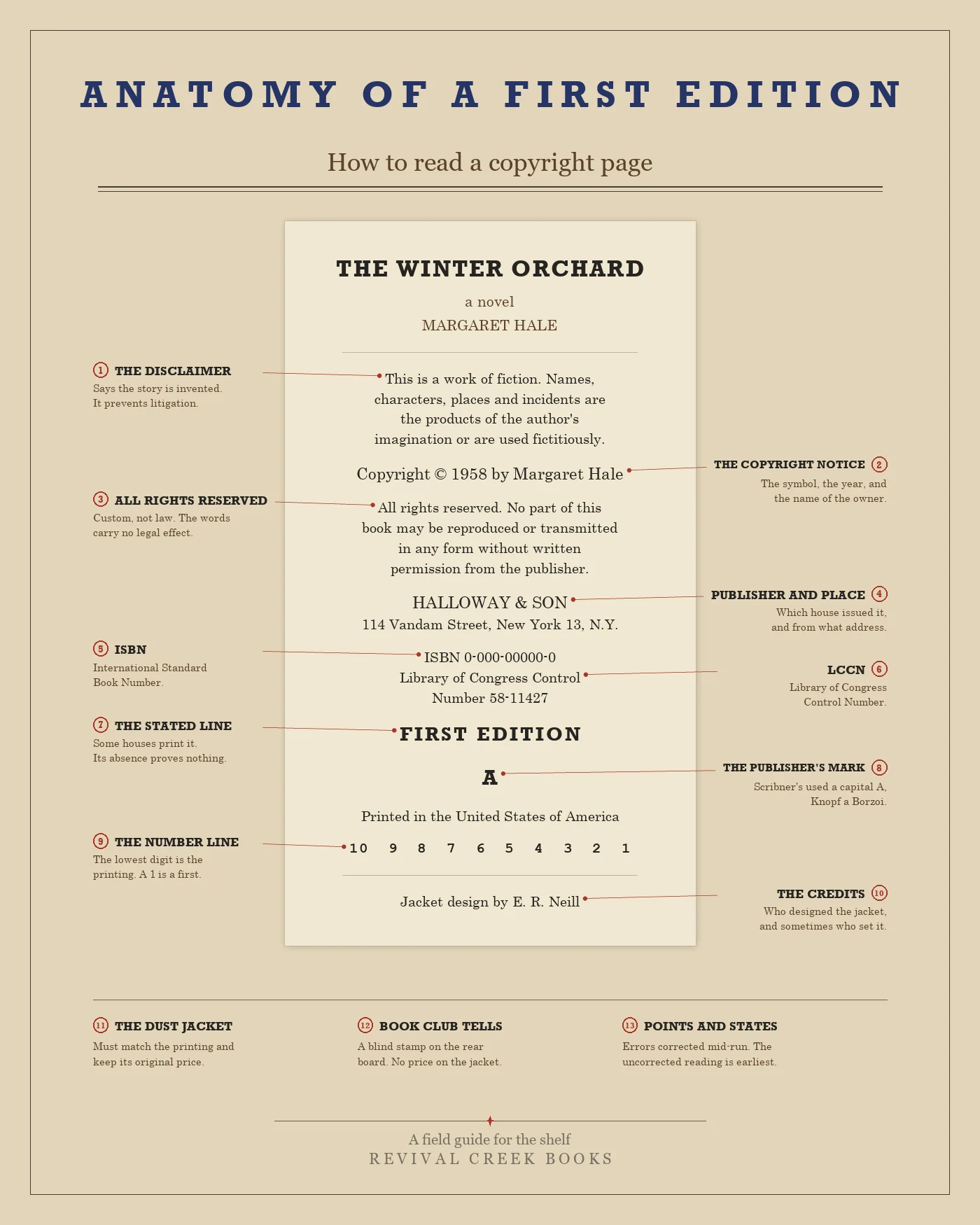
What is on the page, and what each part tells you
- The disclaimer
- Says the story is invented. Purely legal — it tells you nothing about the printing, but its absence on a novel is itself unusual.
- The copyright notice
- The symbol, the year, and the name of the owner. This is the year the TEXT was registered, not the year your copy was made. A 1925 notice in a 1974 reprint is normal and means nothing on its own.
- All rights reserved
- Custom, not law. The words carry no legal effect and no dating information.
- Publisher and place
- Which house issued it, and from what address. Conventions differ sharply by house, so identify the publisher before applying any rule.
- ISBN
- International Standard Book Number. New for every edition and format — and absent entirely before about 1970, which is itself a dating clue.
- LCCN
- Library of Congress Control Number. The catalogue record; useful for confirming the edition you think you have.
- The stated line
- “First Edition”, “First Printing”, or “First published”. Many houses print it outright. Its ABSENCE proves nothing on its own — plenty of true firsts never say so.
- The publisher’s mark
- Scribner’s used a capital A. Knopf a Borzoi. Random House printed “FIRST EDITION”. Learn the house, not a universal rule.
- The number line
- The single most reliable tell. See below.
- The credits
- Who designed the jacket, and sometimes who set the type. Occasionally dates a jacket independently of the book.
The item that states the printing
Of everything above, the number line is the one that answers the question outright: a row of digits near the foot of the page, printed so the printer could strike off the lowest one at each new printing. The lowest digit still present is the printing you are holding.
It is also the item carrying the most exceptions — orderings that run backwards or interleave a year, a house that printed words in place of a digit, and a house whose line argues against the copy rather than for it. Those are the subject of How to Read a Number Line.
Books printed before roughly the 1970s often have no number line at all. For those, the publisher’s own conventions and the first-issue points for that title are what settle it — the first edition checklist runs the whole sequence in order.
Three things the copyright page will not tell you
- The dust jacket. It must match the printing and keep its original price. Often worth more than the book.
- Book-club tells. A blind stamp on the rear board, no price on the jacket, lighter paper, smaller trim. Clubs reprinted this page verbatim, so the page that sends you looking is exactly the one that cannot settle it — the object can.
- Points and states. Errors corrected mid-run. The uncorrected reading marks the earliest sheets — and these are per-title, not general, as Points of Issue sets out.
What it is worth
Values move constantly and depend on condition far more than most people expect. Check what copies are actually listed for rather than trusting a figure from an article.
Check yours with the free tool →
Common questions
- Does a 1925 copyright date mean I have a 1925 book?
- No. The copyright notice records when the text was registered, not when your copy was printed. A reprint from 1970 will still show the original copyright year. Use the number line and the publisher’s own conventions to date the copy.
- Where do I find the copyright page?
- On the verso — the back — of the title leaf, near the front of the book. It is the page most readers turn straight past. It carries the printing information alongside a good deal of legal boilerplate that tells you nothing about your copy.
- My book says “First Edition” — is it valuable?
- Not necessarily. First edition and first printing are different things: a first edition can run to many printings. Value also depends heavily on condition and, for most modern books, on the dust jacket being present, original and unclipped.
- How do I spot a book-club edition?
- Common tells: a blind stamp — a small dot or square pressed into the rear board — no price on the jacket flap, lighter paper, and a slightly smaller trim size than the trade edition. Book-club copies are usually worth a small fraction of a true first.
- Is the dust jacket really that important?
- For most twentieth-century books, yes — often the majority of the value. The jacket must match the printing and retain its original price. A clipped price corner materially reduces what a copy is worth.
Identification guidance only. Not an appraisal, and not legal advice. Where a point is not well documented for a given title, treat it as unverified rather than assuming.